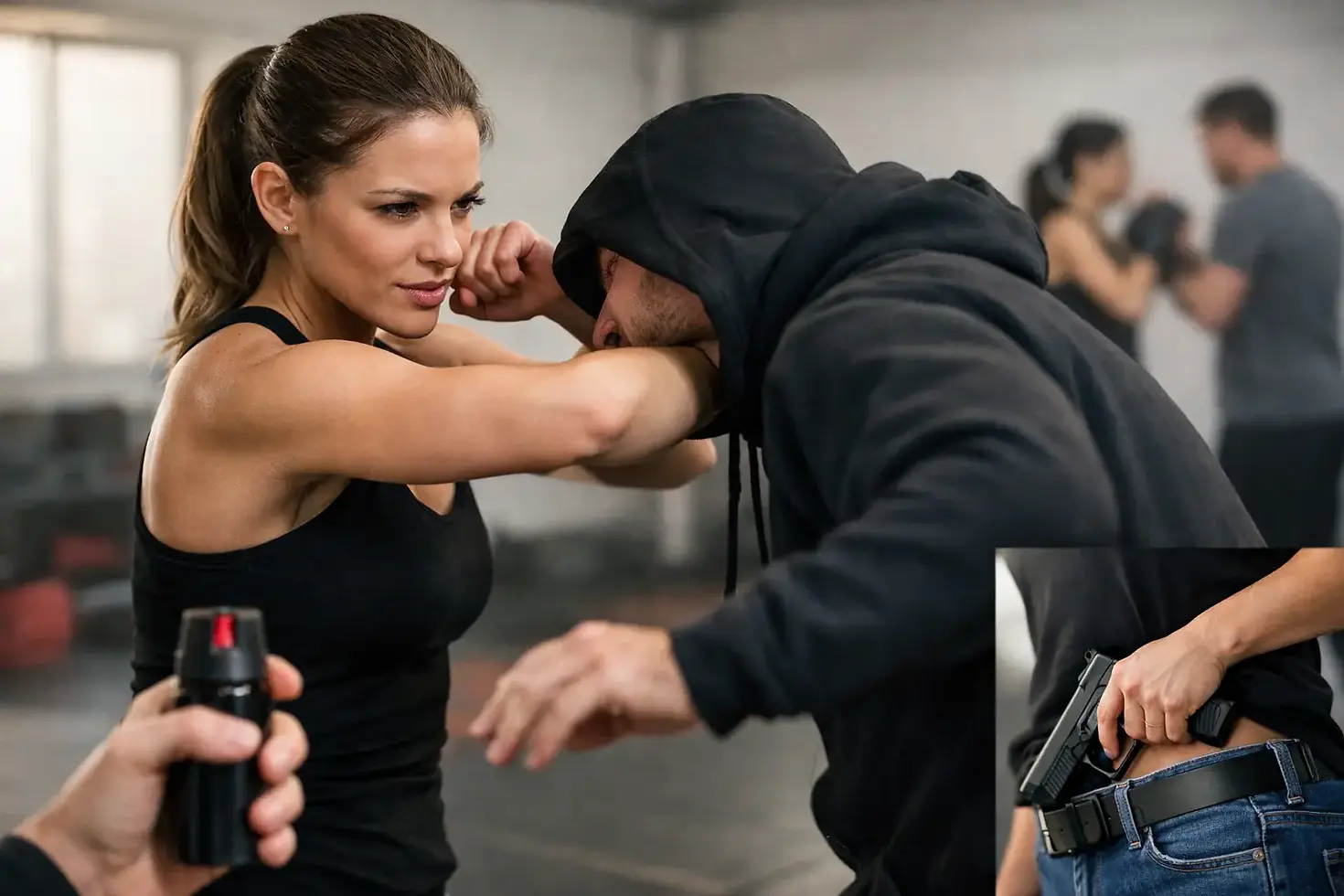
Women's Practical Self-Defense Options That Work

A parking lot that feels different after dark. A stranger who ignores a clear “no.” A tense conversation that begins to close distance. The search for women practical self defense options is rarely about becoming a fighter. It is about having sound judgment, clear boundaries, and a realistic plan when someone else makes a situation unsafe.
Real self-protection is not built on fear. It is built through preparation. The best option depends on your daily routine, physical ability, comfort level, local laws, and willingness to practice. A tool carried but never trained with can create false confidence. A technique learned once can disappear under stress. The goal is not to win a confrontation. The goal is to recognize danger early, create an opportunity to leave, and get home safely.
Women’s Practical Self-Defense Options Start Before Contact
The strongest defensive choice is often made before a physical threat begins. Awareness does not mean living on edge or treating every person as a threat. It means staying present enough to notice what is around you and trusting the signals that tell you something is off.
That may look like keeping your head up instead of becoming absorbed in a phone while walking to your car. It may mean choosing a well-lit route, parking where you can leave easily, or telling a friend when you are meeting someone new. It also means giving yourself permission to leave a situation without explaining, apologizing, or waiting for proof that your discomfort is justified.
Predatory behavior often tests boundaries first. Someone may stand too close, block a path, pressure you to drink, refuse to accept an answer, or try to separate you from other people. These actions deserve a response. A direct voice can interrupt that momentum: “Stop.” “Back up.” “Do not touch me.” Short commands are easier to use under pressure than long explanations.
Build a Layered Personal Safety Plan
There is no single item, class, or tactic that works in every setting. Practical self-defense works best in layers. Think of each layer as another chance to avoid harm and regain control of your choices.
Your first layer is awareness and positioning. Know where exits are. Keep space between yourself and a person who makes you uneasy. If you are in a public place, move toward staff, families, groups, or bright and visible areas. Distance is an advantage. So is refusing to let a stranger draw you into a private or isolated location.
Your second layer is communication. A confident verbal boundary can attract attention, signal that you are not an easy target, and make your intentions clear to witnesses. Practice using your voice at full volume. Many people freeze because they have been taught to be polite, even when politeness no longer serves their safety. Self-protection requires a different standard: be respectful when it is safe, but be firm when safety is in question.
Your third layer is a personal safety device, where legal and appropriate. A charged phone, personal alarm, flashlight, or location-sharing plan can be useful. Each has limits. Phones can lose battery or signal. Alarms may not deter someone who is determined. Defensive sprays and other weapons carry legal restrictions, can be difficult to access under stress, and may be taken or used improperly. Before carrying any device, understand local laws and practice its safe use.
The final layer is physical skill. This matters when avoidance, distance, and verbal boundaries have failed. Physical self-defense should focus on simple, high-percentage actions that help you break contact, protect your balance, get to your feet, and escape.
Train for the Problems That Actually Happen
Many people picture self-defense as a dramatic exchange of punches and kicks. Real incidents are often closer, faster, and messier. They may involve wrist grabs, unwanted holds, being pushed against a wall, being taken to the ground, or trying to protect yourself while frightened and off balance.
That is why practical training should include more than striking a pad. Striking can be valuable because it develops power, posture, and confidence. But a complete program also teaches distance management, escape from grabs, movement from the ground, balance breaking, and how to stand back up safely.
Traditional Jiu-Jitsu can be especially valuable when it is taught through a modern self-protection lens. It gives students a framework for controlling space, escaping common holds, and using leverage instead of relying only on size or strength. The lesson is not that smaller people can overpower anyone. They cannot always do so, and honest training acknowledges that. The lesson is that sound positioning, practiced movement, and decisive action can create the opening needed to get away.
Training should also address the stress response. Under pressure, fine motor skills decline. Memory narrows. Complex sequences become unreliable. A good instructor teaches a small number of repeatable principles, then lets students practice them with increasing resistance in a controlled environment. You do not need a catalog of flashy techniques. You need skills you can recall when your heart rate rises.
What a Good Self-Defense Class Should Include
A worthwhile class is structured, respectful, and realistic without being reckless. Students should learn why a technique works, when it may fail, and what safer alternatives are available. Drills should gradually build pressure rather than forcing beginners into panic.
Look for instruction that includes verbal boundary setting, awareness, escape and evasion, standing and ground defense, and scenario-based decision-making. The culture matters as much as the curriculum. An ego-driven room where students are mocked, overwhelmed, or treated as targets is not a place to build confidence. Serious training can be demanding while still being disciplined, ethical, and supportive.
At Vanguard Academy, practical self-protection is taught alongside the traditional values that give training its purpose: respect, humility, self-control, and responsibility. Those values are not decorations around the lesson. They shape how students train, how they treat partners, and how they make decisions under pressure.
Choose Tools Carefully, Not Emotionally
It is understandable to want the fastest possible solution. A keychain device, a sharp object, or a weapon can feel reassuring because it appears to offer instant power. Yet every tool requires access, judgment, legal knowledge, and repeated practice. In close range, a weapon may be hard to reach. In a struggle, it may be dropped or turned against its owner.
That does not mean tools have no role. It means they should support a broader safety plan, not replace one. A personal alarm may be ideal for someone who wants to draw attention quickly. A bright flashlight can improve visibility and help identify hazards. A phone safety feature can help a trusted contact respond when you need support. Choose what fits your life, then rehearse how you would use it.
Avoid carrying anything solely because it is marketed as “women’s self-defense.” Marketing does not make an item legal, effective, or safe. Ask practical questions instead: Can I access it under stress? Have I trained with it? Does it create distance or force me closer? Can it help me leave?
Confidence Comes From Repetition
Confidence is not pretending danger cannot happen. It is knowing you have choices and have practiced using them. The first class may feel unfamiliar. You may discover that your voice is quieter than you expected or that escaping a simple grip takes more effort than it looked online. That is not failure. That is valuable information, gained in a controlled setting rather than during a crisis.
Consistent practice changes more than technique. You begin to carry yourself differently. You notice exits. You set boundaries earlier. You become more comfortable taking up space and saying no without apology. Those habits can reduce risk long before physical defense becomes necessary.
If you are considering training, choose a program that challenges you without feeding fear. Bring questions. Ask how scenarios are taught, whether instructors explain legal and ethical considerations, and whether beginners can progress at a safe pace. The right environment will help you build capability steadily, with no need to prove anything to anyone.
Your safety is worth more than a one-time lesson or a product kept at the bottom of a bag. Start with awareness, strengthen your boundaries, and train the skills that help you move, escape, and go home. Small, disciplined steps taken now can become calm, capable action when it matters most.


Comments